
Every year, thousands of people apply for Canada immigration seeking better jobs, higher salaries, and permanent residency opportunities.
But most people ask the same question:
“Am I eligible to immigrate to Canada in 2026?”
The good news is:
You don’t need an immigration lawyer to get a basic idea.
You can do a simple self-assessment before starting your visa application.
Let’s break it down in an easy way.
Step 1: Your Age (CRS Score Factor)
Canada’s main immigration system — Express Entry — gives points based on age.
- The highest points are awarded between 20 and 29 years old.
- After age 30, points gradually decrease.
- Applicants over 40 can still apply, but other factors like education and work experience become more important.
👉 Age does not automatically disqualify you — it only affects your CRS score (Comprehensive Ranking System).
Canada Immigration Eligibility Check – 2026
Canada Immigration Eligibility Check – 2026
Step 2: Your Education
Education is a major factor in qualifying for Permanent Residency (PR).
You may qualify if you have:
- High school diploma
- College certificate
- Bachelor’s degree
- Master’s or PhD
Higher education = more CRS points.
Important:
Foreign degrees must be evaluated through an Educational Credential Assessment (ECA) from approved organizations like WES.
Step 3: English or French Language Test
To apply through Express Entry or most skilled worker programs, you must take an approved language test:
- IELTS or CELPIP (English)
- TEF Canada (French)
You don’t need perfect English.
But a higher test score significantly increases your immigration points and improves your chances of receiving an Invitation to Apply (ITA).
Language ability is one of the highest-impact factors in Canada immigration programs.
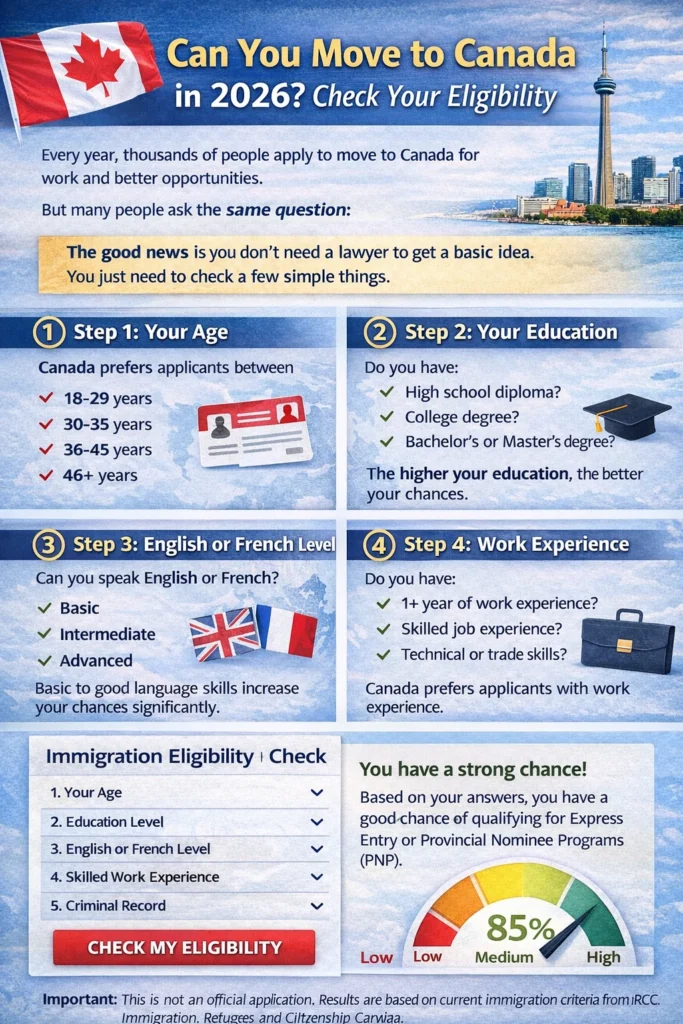
Step 4: Work Experience
Canada prefers skilled workers.
You usually need:
- At least 1 year of full-time work experience
- Experience in a skilled occupation (TEER category under NOC system)
- Paid work (volunteer work does not count)
More years of experience = more CRS points.
Skilled trades, healthcare, IT, engineering, and transport sectors are often in demand.
Main Immigration Programs in 2026
Here are the most common legal pathways:
1️⃣ Express Entry (Federal Skilled Worker Program)
For skilled workers with education, language ability, and experience.
2️⃣ Provincial Nominee Program (PNP)
Canadian provinces select candidates based on local labor market needs.
3️⃣ Work Permit Programs
Temporary work permits can lead to permanent residency later.
4️⃣ Study Visa Pathway
International students can study in Canada and later apply for PR through Canadian work experience.
Quick Self-Check: Do You Have a Good Chance?
You may have strong potential if you:
✔ Are under 40
✔ Have at least high school education
✔ Can pass an English or French test
✔ Have 1 year or more of skilled work experience
If yes — you may qualify to create an Express Entry profile.
How to Increase Your Chances in 2026
You can improve your immigration eligibility by:
- Improving your IELTS score
- Gaining more skilled work experience
- Getting a valid Canadian job offer (LMIA-supported)
- Applying through a Provincial Nominee Program
- Studying in Canada first
A provincial nomination can add 600 CRS points, which almost guarantees an invitation for permanent residency.
Important: Always Check Official Sources
Immigration policies change frequently.
Before paying any immigration consultant or lawyer, always check official information on:
👉 Government of Canada website (canada.ca)
👉 IRCC (Immigration, Refugees and Citizenship Canada)
Avoid scams and unlicensed immigration consultants.
Final Thoughts
Canada remains one of the top destinations for skilled workers, international students, and families seeking permanent residency and economic opportunity.
If you meet the basic requirements, 2026 could be your opportunity to start a new life in Canada.